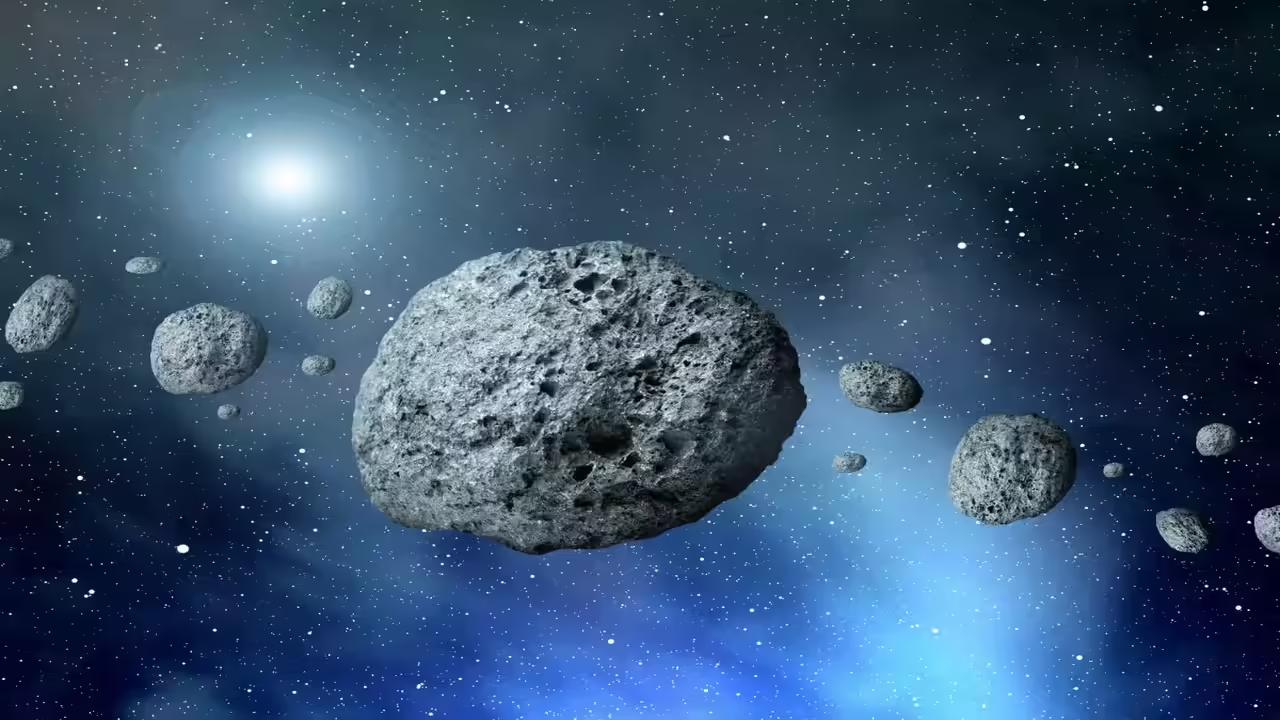
Imagine looking up at the night sky, marveling at the stars, only to realize that a massive space rock could be hurtling toward our planet. It’s the stuff of science fiction blockbusters, but for NASA, tracking potentially hazardous asteroids is a very real and critical mission. These cosmic threats, remnants of the solar system’s chaotic past, could cause catastrophic damage if they collide with Earth. In this article, we’ll dive into the five most dangerous asteroids NASA is keeping a close eye on, exploring their risks, what makes them so threatening, and how humanity is preparing to defend our planet.
What Are Potentially Hazardous Asteroids?
NASA defines Potentially Hazardous Asteroids (PHAs) as space rocks larger than 140 meters (460 feet) that come within 7.5 million kilometers (4.6 million miles) of Earth’s orbit. These asteroids are big enough to cause significant regional or even global devastation if they strike. NASA’s Center for Near Earth Object Studies (CNEOS) uses the Sentry system to monitor these threats, analyzing their orbits to predict potential impacts over the next century.
Why Do Asteroids Pose a Threat?
Asteroids are remnants from the solar system’s formation, and some have orbits that cross Earth’s path. A collision could release energy equivalent to billions of tons of TNT, causing widespread destruction. The 2013 Chelyabinsk meteor, a mere 18 meters wide, injured over 1,600 people when it exploded in the atmosphere, highlighting the danger even smaller asteroids pose.
The Top 5 Most Dangerous Asteroids
NASA’s Sentry Risk Table lists asteroids with the highest probability of impacting Earth. Let’s meet the top five culprits, ranked by their potential threat based on size, orbit, and impact energy.
1. Asteroid 101955 Bennu (1999 RQ36)
Discovered in 1999, Bennu is NASA’s top-priority threat due to its size and relatively high impact probability. This carbonaceous asteroid, about 490 meters wide, could release 1.4 billion tons of TNT upon impact—enough to cause regional devastation. It has a 1 in 2,700 chance of hitting Earth on September 24, 2182. NASA’s OSIRIS-REx mission studied Bennu up close, collecting samples that revealed organic materials, offering clues about the origins of life.
2. Asteroid 29075 (1950 DA)
First spotted in 1950 and rediscovered after 50 years, 1950 DA is a massive 1.3-kilometer-wide rubble-pile asteroid. With a 1 in 34,500 chance of striking Earth on March 16, 2880, its impact could release 75 billion tons of TNT, potentially causing a global catastrophe. Its loose, rocky structure makes it particularly tricky to deflect, as it could break apart unpredictably.
3. Asteroid 2023 TL4
Discovered in 2023, this 47-million-ton asteroid quickly earned a spot on NASA’s radar. It has a 1 in 181,000 chance of hitting Earth on October 10, 2119, with an impact energy of 7.5 billion tons of TNT. Though its odds are low, its recent discovery and uncertain orbit make it a priority for further observation.
4. Asteroid 2007 FT3
This “lost” asteroid, unseen since 2007, has a poorly constrained orbit, making predictions challenging. It has a 1 in 10 million chance of impacting Earth on March 3, 2030, with a potential energy release of 2.6 billion tons of TNT. While the odds are slim, its size (0.34 kilometers) could cause significant regional damage if it hits.
5. Asteroid 1979 XB
Another “lost” asteroid, 1979 XB hasn’t been observed in over 40 years, leaving its orbit uncertain. It has a 1 in 1.8 million chance of striking Earth on December 14, 2113, with an impact energy of 30 billion tons of TNT. Its 0.66-kilometer diameter makes it a serious threat if it were to collide with Earth.
Comparing the Threats: A Closer Look
To understand the scale of these dangers, let’s compare these asteroids to the Chicxulub impactor, which wiped out the dinosaurs 66 million years ago. That asteroid, roughly 10 kilometers wide, released energy equivalent to 72 trillion tons of TNT. While none of the current threats match that scale, their potential for regional or global devastation is still alarming.
| Asteroid | Size (km) | Mass (million tons) | Impact Probability | Impact Date | Energy (billion tons of TNT) |
|---|---|---|---|---|---|
| Bennu | 0.49 | 74 | 1 in 2,700 | Sep 24, 2182 | 1.4 |
| 1950 DA | 1.3 | 78 | 1 in 34,500 | Mar 16, 2880 | 75 |
| 2023 TL4 | Unknown | 47 | 1 in 181,000 | Oct 10, 2119 | 7.5 |
| 2007 FT3 | 0.34 | 54 | 1 in 10 million | Mar 3, 2030 | 2.6 |
| 1979 XB | 0.66 | 390 | 1 in 1.8 million | Dec 14, 2113 | 30 |
How Do These Asteroids Compare to Apophis?
Asteroid 99942 Apophis, once a major concern, was downgraded in 2021 after observations confirmed it won’t hit Earth for at least 100 years. On April 13, 2029, it will pass just 31,600 kilometers above Earth—closer than some satellites—but poses no immediate threat. Compared to Bennu, Apophis is smaller (370 meters) but was once rated higher on the Torino scale due to its initial 2.7% impact probability.
Why These Asteroids Are So Dangerous
Each asteroid’s threat level depends on its size, orbit, and composition. Here’s why they’re on NASA’s watchlist:
- Size: Larger asteroids like 1950 DA can cause global catastrophes, while smaller ones like 2007 FT3 could devastate cities.
- Orbit Uncertainty: “Lost” asteroids like 2007 FT3 and 1979 XB have poorly defined orbits, making predictions difficult.
- Impact Energy: Even a “small” asteroid like 2023 TL4 could release energy equivalent to thousands of nuclear bombs.
The Human Cost of an Impact
Picture a city-sized asteroid striking a populated area. The 1908 Tunguska event, caused by a 50–80-meter asteroid, flattened 2,000 square kilometers of Siberian forest. A similar impact today could kill millions if it hit a city. Bennu’s potential impact in 2182 could cause regional devastation, disrupting economies and ecosystems. The emotional weight of such a scenario is heavy—imagine the fear and urgency of preparing for a cosmic collision.
NASA’s Planetary Defense: How We’re Fighting Back
NASA isn’t sitting idly by. The Planetary Defense Coordination Office (PDCO) leads efforts to detect, track, and potentially deflect dangerous asteroids. The 2022 DART mission successfully altered the orbit of Dimorphos, proving kinetic impactors can work. Future missions, like OSIRIS-APEX and ESA’s RAMSES, will study Apophis during its 2029 flyby to refine deflection strategies.
Pros and Cons of Current Deflection Methods
Pros:
- Kinetic impactors (like DART) are proven effective for smaller asteroids.
- Gravitational tractors could nudge asteroids without breaking them apart.
- Nuclear deflection could work for larger threats if timed correctly.
Cons:
- Missions require years of planning and precise timing.
- Rubble-pile asteroids like 1950 DA may fragment unpredictably.
- Limited observation windows for “lost” asteroids complicate planning.
People Also Ask (PAA)
Here are answers to common questions about dangerous asteroids, sourced from Google’s PAA:
What is the most dangerous asteroid to Earth?
Currently, Bennu (101955) poses the greatest risk, with a 1 in 2,700 chance of impacting Earth in 2182. Its size and potential energy release make it a top priority for NASA.
How likely is an asteroid to hit Earth?
NASA estimates that no known asteroid poses a significant threat for at least 100 years. However, smaller, undetected asteroids could strike with little warning, as seen in the Chelyabinsk event.
Can we stop an asteroid from hitting Earth?
Yes, methods like kinetic impactors, gravitational tractors, and nuclear deflection are being developed. The DART mission’s success is a promising step forward.
Where can I track asteroid close approaches?
Visit NASA’s Jet Propulsion Laboratory (JPL) Small-Body Database or the Asteroid Watch Dashboard for real-time data on near-Earth objects.
Tools and Resources for Asteroid Tracking
For those eager to dive deeper, here are the best tools to stay informed:
- NASA’s Asteroid Watch Dashboard: Provides real-time updates on upcoming close approaches.
- Sky Tonight App: Tracks asteroids’ positions in the sky using their names or numbers.
- ESA’s Risk List: Lists potentially hazardous asteroids with detailed risk assessments.
These tools empower amateur astronomers and curious readers to monitor cosmic threats from their phones or computers.
A Personal Reflection on Cosmic Threats
When I was a kid, I remember watching a meteor shower with my dad, lying on a blanket in our backyard. The streaks of light were magical, but the thought of a rogue asteroid crashing into Earth was terrifying. Years later, learning about NASA’s efforts to track and deflect asteroids feels like a reassuring pat on the back from science. It’s humbling to think that humanity, despite our smallness in the universe, is finding ways to protect our home. The blend of awe and urgency in this work is what makes it so compelling.
FAQ: Your Questions Answered
1. What makes an asteroid “potentially hazardous”?
An asteroid is classified as a PHA if it’s larger than 140 meters and comes within 7.5 million kilometers of Earth’s orbit. These criteria indicate a potential for significant damage.
2. Could an asteroid like Chicxulub hit Earth again?
While no known asteroid matches Chicxulub’s size, large PHAs like 1950 DA could cause global devastation. NASA estimates such impacts occur every 500,000 years.
3. How does NASA track asteroids?
NASA uses telescopes like Pan-STARRS and the Catalina Sky Survey, combined with the Sentry system, to monitor asteroid orbits and predict potential impacts.
4. What happens if an asteroid is on a collision course?
NASA would coordinate with global agencies to assess deflection options, such as kinetic impactors or gravitational tractors, depending on the asteroid’s size and trajectory.
5. Are there any asteroids heading for Earth soon?
No known asteroids pose an immediate threat. The closest known approach is Apophis in 2029, which will safely pass 31,600 kilometers from Earth.
Conclusion: Staying Vigilant in a Cosmic Neighborhood
The universe is a wild place, and asteroids remind us of its unpredictability. NASA’s tireless work to track and study these space rocks gives us hope that we can protect Earth from cosmic threats. By understanding the dangers of Bennu, 1950 DA, and others, we’re not just preparing for worst-case scenarios—we’re showcasing humanity’s resilience and ingenuity. So, the next time you gaze at the stars, take a moment to appreciate the scientists working to keep our planet safe. Want to stay updated? Check out NASA’s Asteroid Watch for the latest on near-Earth objects, and let’s keep looking up—cautiously.